The presentation of the objectives of the "Innovative actions against illegal poisoning in EU Mediterranean pilot areas" was held in Kalambaka last Tuesday, February 21, by ARCTUROS and the University of Crete - Museum of Natural History of Crete. ελληνικά
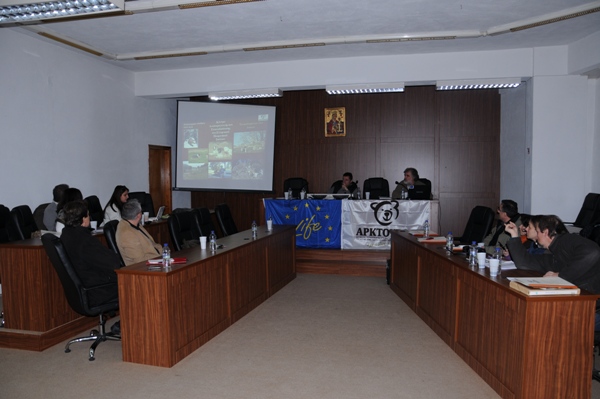
The presentation of the objectives of the "Innovative actions against illegal poisoning in EU Mediterranean pilot areas" was held in Kalambaka last Tuesday, February 21, by ARCTUROS and the University of Crete - Museum of Natural History of Crete.
Noteworthy was the presence of representatives of local government and regional bodies. The Mayor of Kalambaka, Mr Dimitris Sakellariou, showed a great interest in the program and declared the commitment of the City of Kalambaka with the project.
The meeting was also attended by the mayor Mr. J. Zaropoulos, the mayor’s councilors Mr Koufochristos and Mr D. Karakostas, representatives of the Ministry of Environment, Energy and Climate Change-Special Secretariat for the Forests, Mr. P. Drougas and E. Giakoumi, from the Forestry Department of Grevena, Mr. M. Skakas, Mr D. Drizas, from the Forest Service of Trikala and Kalampaka, Mr. D. Kalogiros and Mr. S. Mouziouras. Finally, representatives from the Directorate of Coordination and Forest Inspection of Crete and representatives from the local authorities and media also assisted to the event.
The board set up the National Programme Monitoring Committee which met for the first time in order to ensure the reliability and validity of the actions and the outcomes of the program. The National Advisory Commission will help and propose further suitable measures for its implementation at local level in order to resolve the problem.
Dimitris Bousmpouras, environmentalist and research associate of ARCTUROS recalled that a previous meeting was hold in 1999 at Dadia between environmental organizations and stakeholders to identify and solve the same problem, but unfortunately, consensus was not achieved and therefore, and so was not an agreement on common actions of all stakeholders.
Antonis Rigas, the project coordinator for ARCTUROS, pointed out that Spain (specifically the organization Fundacion Gypaetus) is being aware of the problem for 15 years and tries to implement this LIFE program to solve the problem throughout Europe. The National Commission should operate in perpetuity in order to cope with the problem nationwide.
Michalis Probonas, project coordinator for the University of Crete-Natural History Museum of Crete, stressed the importance of creating networks within the frame of the project, namely the European networks of farmers, municipalities and Hunters.
Victoria Saravia, representing the Greek Ornithological Society, commented their experience fighting the use of poisoned baits and how it influences the reduction in the extinction of birds of prey in Epirus. She also emphasized the importance of combining both programmes, as synergies can be developed to achieve even greater results.
Dr. Stavros Xirouchakis, Project Manager of the programme for the University of Crete MFIK says: "The problem of using poisoned baits exists all over the world where farming is practiced and there are predator animals, especially after the formalization of the overuse (of the baits)”. The problem is well known in most of Mediterranean countries. South Africa is also an example, where baits are addressed to animals-predators and where their use ended up with the extinction of whole colonies of endangered animals. In India, an estimated large number of about 1,000,000 vultures died poisoned due to its role of “cleaners” of the country eating carcases and garbage. Crete has been chosen as pilot area for implementing the programme because it has a larger population of vultures and other raptors in relation to mainland Greece, where populations have collapsed.
The debate about the creation of the European Networks against illegal use of poisoned baits raised a great interest among those presents. So did the free telephone line against poison implemented by ARCTUROS , operating 24 hours a day for residents in Meteora-Kalampaka: 0101 800 11 01 (landline phone).
As a proof for the absolute necessity of implementing the program activities, there has been recently reported a poisoning incident with two death vultures, four eagles and a female hawk at the region of Nestos river. The birds were found dead because of poisoned baits that were placed in order to kill wolves.
The discussion ended with a great selection of local and individual specific pilot actions in synergy with all stakeholders to achieve the maximum possible information and awareness-raising of the productive groups and residents in areas with larger problems, as with environmental education.
For more information:
Zoi Karanika / ARCTUROS-Office Kalampakas/6989395484
Vaso Petridou/ARCTUROS/6937422537
Michael Probonas / University of Crete-MFIK/6977618329
|
 Home
Home Contact
 Home -> News > See this new
 Press Conference on the illegal use of poisoned baits control plan